Quick Quack Car Wash Review

A single Quick Quack wash runs $10 to $28 depending on the tier the basic exterior wash sits near the bottom, the top unlimited plan near the top. Wash twice a month and the unlimited plan already pays for itself.
The tunnel itself is quick, usually under five minutes, and the entry-level wash is genuinely one of the cheapest in the category.
The plan makes sense if you’re washing weekly. The cancellation isn’t a one-click process most locations require you to cancel in person or through a phone call, not through the app or website, which the sign-up page doesn’t mention.
- Three tiers, all duck-themed Good, Lucky Duck, and Ceramic Duck.
- Unlimited plans run about $20 to $40 a month and work at any Quick Quack location.
- The tunnel is exterior-only. Vacuums are free and self-serve at most locations, not all of them.
- Cancelling needs 10 days notice before your renewal date, and quitting inside 45 days can carry a $5 fee.
- 330+ locations across nine states, concentrated in Texas, Utah, California, and Arizona.

Quick Quack Wash Tiers & Prices
Quick Quack sells three wash tiers and nothing else. There is no fourth option, no interior package, and no hand-wash upgrade.
| Tier | Single Wash |
|---|---|
| Good | $10–$15 |
| Lucky Duck | $17–$23 |
| Ceramic Duck | $24–$28 |
These are ballpark numbers your actual price depends on your zip code.
Quick Quack prices by market instead of publishing a flat list, which is why you’ll need to enter your zip on their wash plans page to see real numbers for your area.
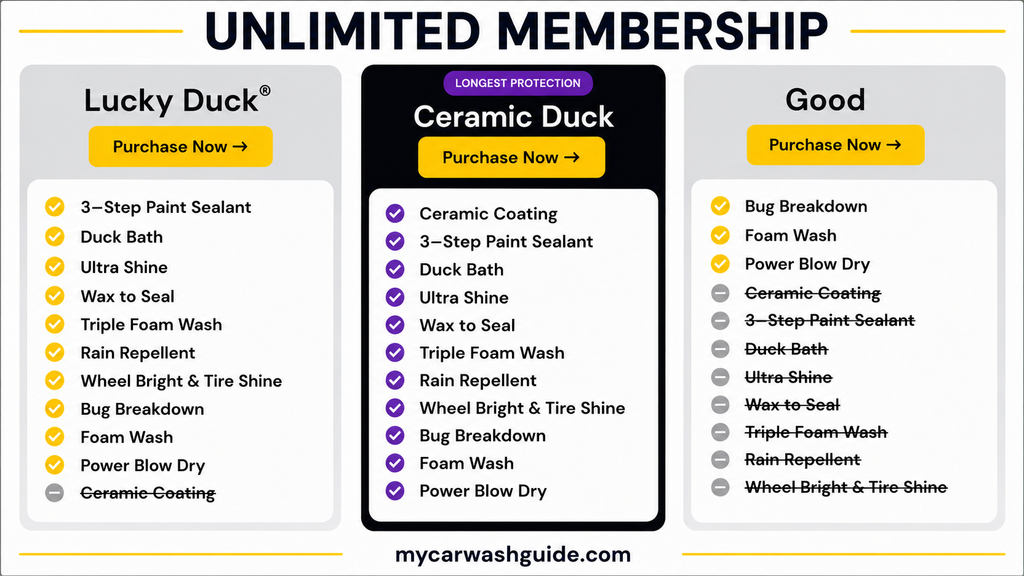
The tier names don’t tell you much, so here’s what you’re actually paying for.
Bug breakdown softens insect residue before any cloth touches the paint it matters more than it sounds, since dried bugs are one of the main things that scratch a car in a tunnel.
Lucky Duck adds a 3-step paint sealant and wax to seal, sprayed on as you pass through. Expect a few weeks of gloss and water beading, not months.
Ceramic Duck is the one worth understanding before you pay for it. A tunnel-applied ceramic isn’t the same product a detailer cures onto your clear coat over several hours that version lasts years and costs hundreds.
This one’s sprayed on in about ten seconds and lasts a few weeks. It’s available at every location, so availability isn’t the reason to skip it. Value is.
Unlimited Membership Cost
Every tier breaks even at two washes a month. That’s not a coincidence it’s how the pricing is designed.
| Tier | Monthly Plan | Washes to Break Even |
|---|---|---|
| Good | $20–$25 | 2 |
| Lucky Duck | $27–$33 | 2 |
| Ceramic Duck | $34–$40 | 2 |
Run the Lucky Duck numbers. A single wash runs about $20, and the plan runs about $30. Two washes and you’ve covered it. Four washes and you’re down to $7.50 a wash instead of $20.
Break-even at two washes only helps you if you actually go twice.
Most drivers wash once or twice a month, which puts them right on the line or below it. If that’s you, pay per wash and keep the flexibility.
The plan is a clear win at three visits a month, and an obvious one if you’re washing weekly. Our breakdown of how often a car actually needs washing is worth reading before you commit to a monthly charge.
A prepaid wash gets used, and a car washed weekly spends less time with road grime sitting on the paint. A plan you forget about is worse than paying cash.
Cross-shopping helps too. Mister Car Wash’s plan pricing sits in a similar band, so in markets where both operate, the decision usually comes down to which one’s on your commute.
Adding a Second Car
Plans are tied to one vehicle, not to you. The membership reads your license plate, so a second car needs its own plan.
Quick Quack discounts this through Flock Pricing autopay plans only, one Flock plan per household, and a ceiling of five active vehicles at a time.
Swapping a vehicle in or out is handled case by case rather than automatically.
Refer a friend and you earn a $5 credit on your bill, up to $20 a month, while they get 60% off their first month. That doesn’t expire the way promo codes do.
Cancellation Terms
Quick Quack’s membership page says cancel anytime. The terms of service say something narrower, and the gap between the two is where people get charged.
Per Quick Quack’s own terms of service, you cancel by giving notice at least 10 days before your renewal date, by email or by phone. Cancel on day eight and you can still be billed for another month.
Cancelling within 45 days of signing up can trigger a $5 cancellation fee, applied at the company’s discretion. That’s worth knowing before you sign up to test the wash for a month.
Your renewal date is the calendar day you joined, give or take a business day. Join on the 5th and you’re billed around the 5th every month after that.
Payments are non-refundable and mid-cycle cancellations are not prorated.
The terms void any cancellation submitted by a third party, so subscription-cancelling apps and your bank’s card block won’t end the membership. Only a request you send yourself counts.

Paint Damage Risk
Quick Quack is a soft-touch tunnel, which means cloth physically contacts your paint. Any wash built this way can leave marks, and pretending otherwise would be dishonest.
The mechanism is worth understanding because it changes what you should do. The cloth itself isn’t what scratches a car.
Grit already sitting on the car gets dragged across the clear coat by the cloth, so a vehicle arriving caked in dried mud or beach sand is the one that comes out with swirl marks.
Dark paint is where this shows. Black and dark grey finishes reveal swirls under direct sunlight that would be invisible on silver, which is why the complaints cluster around dark cars.
If you drive one, washing a black car without adding swirl marks covers what actually helps.
Rinse a heavily soiled car before the tunnel, or skip the tunnel entirely that day. A freshly corrected or ceramic-coated finish is also a poor candidate for any weekly soft-touch wash.
Vehicles That Don’t Fit
Quick Quack’s terms exclude what it calls non-compatible vehicles, defined as anything incompatible by size, design, or modification, plus anything with accessories or trailers attached.
In practice that means roof racks, cargo boxes, bike racks, lifted trucks, dual rear wheels, and oversized aftermarket accessories.
Tunnel dimensions vary by site, so a truck that clears one location may not clear another.
Call the specific location before the first visit if your vehicle is modified, unusually tall, or carrying anything on the roof.
The terms also restrict membership to personal use, which rules out fleet and rideshare-owned vehicles being run on a consumer plan.
Where Quick Quack Operates
Quick Quack lists 330+ locations across nine states Arizona, California, Colorado, Hawaii, Nevada, Oklahoma, Texas, Utah, and Washington.
Coverage is nothing like even. Texas, Utah, and inland California carry the bulk of the sites, with dense clusters around Houston, Corpus Christi, the Rio Grande Valley, Salt Lake County, Sacramento, and the Inland Empire.
Arizona and Nevada are solid. Colorado is concentrated almost entirely around Colorado Springs.
Oklahoma and Hawaii are the thin ends. Hawaii currently has a single site in Kapolei, and several Oklahoma locations are still marked as coming soon on the Quick Quack locations finder.
Your membership works at any location, which is genuinely useful if you drive between Texas metros or split time between California and Nevada.
It’s worth nothing at all if you move to the Midwest or the East Coast, where Quick Quack has no presence.
Vacuums are free and self-serve at most locations, but not every site has them a handful of smaller or older Quick Quack tunnels skip the vacuum area entirely.
Worth checking your local site page or calling ahead if free vacuums are the reason you’re picking Quick Quack over a competitor.
Water Savings Claim
Quick Quack publishes real numbers here, which is more than most chains do.
Its reclamation system filters up to 99% of the water used in a wash, bringing fresh water use down to about 20 gallons per car against roughly 100 gallons for a driveway wash.
Soaps are biodegradable, nothing discharges into storm drains, and every location runs LED lighting. The company holds Green Certified Car Wash status.
The comparison holds up driveway washing sends detergent and grime straight into waterways, while a commercial tunnel routes wastewater to treatment.
The catch is scale, not per-wash efficiency. When a Corpus Christi investigation pressed the company on local water use during a drought, Quick Quack declined to say how many cars pass through daily.
Twenty gallons a car is a good number. Twenty gallons times an undisclosed volume isn’t a number at all.
Zips competes on the same speed and membership pitch without publishing comparable reclamation figures which puts Quick Quack ahead here.
What Customers Complain About
Complaints cluster in three places, and only one of them is Quick Quack’s fault.
- Water spots Express tunnels finish with a blower rather than a hand dry, so anything the air misses dries on the paint, and hard-water markets make it worse. Grabbing a free towel from the pond area on the way out solves most of it, and our ranking of the safest ways to dry a car covers the rest.
- Missed coverage on trucks Step bars, deep bumper crevices, and the area behind the rear wheels get skipped. That’s a format limitation of every conveyor tunnel, not a Quick Quack failing.
- Billing This one lands squarely on the company. Renewal charges arriving after someone thought they had cancelled are the recurring theme, which tracks with the 10-day notice requirement in the terms.

Praise is consistent and boring in the good way fast, cheap, clean result, strong vacuums, friendly staff. For an express wash, that’s the whole job.
The Tier I’d Actually Pay For
Lucky Duck no hesitation.
It has the sealant, rain repellent, wheel and tire treatment, and triple foam everything that makes a wash actually look like it did something. Good to Lucky Duck is a visible jump.
Lucky Duck to Ceramic Duck just adds about seven dollars a month for a spray coating that lasts a few weeks the weakest value on the menu.
Put that toward a proper hand wax twice a year instead; your paint comes out better protected for less.
Skip the plan if you wash once a month, your car stays garaged, or you own a dark car you care about. Buy Good singles as needed and you’ll pay less than half the plan cost.
Quick Quack isn’t a detailing substitute and doesn’t claim to be. It’s fast, cheap, exterior-only, with an honest environmental record and a fussy cancellation clause. Judge it on those terms it holds up well.