5 Methods to Dry a Car After Washing


Tap water isn’t as clean as it looks it can carry 300-500 parts per million of dissolved minerals like calcium and magnesium, and every drop that air-dries on your paint leaves those minerals behind as a spot.
Wipe it wrong, or not at all, and you trade a clean wash for a car covered in chalky rings.
The difference between a flawless finish and swirl marks comes down to three things which tool you use, how you move it, and whether you add a drying aid.
Some methods below beat others on speed, some on protecting the paint, and picking the right one depends on what you’re working with.
If you drive a dark vehicle where every imperfection shows, our guide on how to wash a black car covers the extra precautions worth taking during both washing and drying.
- Only 1 of 5 drying methods avoids both swirl marks and water spots.
- Drying aids cut dry time by 40-60%.
- Thin, low-GSM towels raise swirl risk
Blower and Drying Aid
This is the safest method, and the one professional detailers default to. Start with a blower on mirrors, door handles, and the grille to clear bulk water without touching the paint.
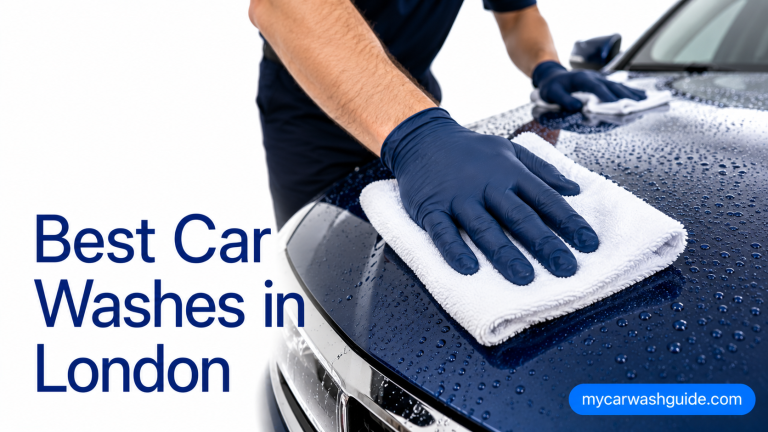
Then spray a drying aid across one panel at a time and wipe with a high-quality microfiber towel, laying it down rather than dragging it.
The laying motion matters most. Set the towel flat on the panel and let it absorb water instead of pulling it across the surface.
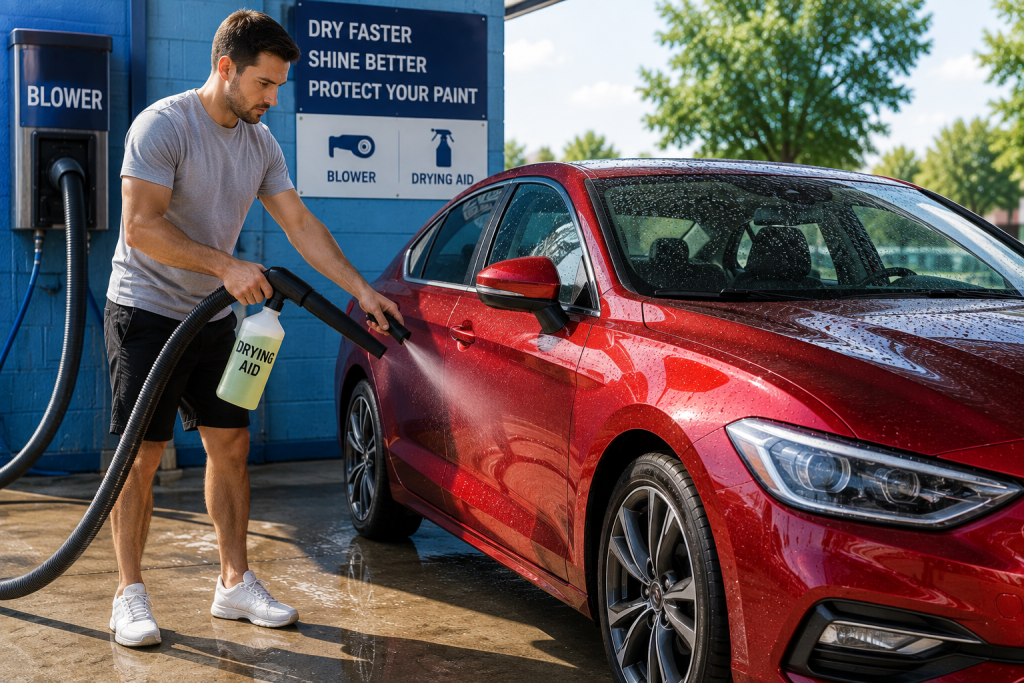
Work top to bottom roof, hood, sides, bumpers. The drying aid cuts friction between towel and paint, which is what keeps swirl marks off.
Swirl risk is low, water spot risk is zero, and the whole process takes 10-12 minutes. Expect to spend $10-30 on a drying aid and $20-40 on a proper microfiber towel.
Microfiber Towel Method
You can dry with just a towel, but only if it’s the right one, and you accept some risk.
Look for 1200+ GSM grams per square meter with a twisted or looped weave. Anything under 800 GSM will scratch your paint, budget or not.
Even premium microfiber won’t stop water spots. Tap water minerals deposit as the last bit of moisture evaporates, and without a drying aid there’s nothing counteracting that.
Soft water areas might get away with it; hard water regions will see spots form within hours. If spots have already set in, our guide on how to remove water spots from your car covers the correction process.
Swirl risk is medium even with good technique, water spot risk is high. Figure 15-20 minutes, and the only cost is the towel itself $20-40 for one worth using.

Blower Alone, No Drying Aid
This sits between the full combo above and doing nothing at all. You keep the touchless benefit no contact means no friction-based swirl risk but you’re skipping the spray that actually neutralizes minerals in the water.
Forced air clears most of the water before it has a chance to sit and evaporate, so spotting drops compared to plain air drying.
It won’t eliminate the risk the way a drying aid does, especially in hard water regions where a hot panel can out-evaporate even a fast air stream.
Zero swirl risk, moderate water spot risk the middle ground of the five. Takes 8-10 minutes; a dedicated electric blower runs $40-100 skip gas models, they can spit oil residue onto wet paint.
Chamois or Squeegee
This is the method most detailers actively warn against. A chamois or rubber squeegee clears water fast, but through direct, high-contact pressure dragging any trapped grit straight across the clear coat instead of lifting it away.
It’s one of the most common causes of fine linear scratches on daily-driven cars.

Works fine on glass. On painted panels, it’s a gamble every time, since the contact itself is the problem, not the tool or the technique.
High swirl risk, but water spot risk stays low since it clears water so quickly. About 8-10 minutes, and $10-20 for a decent chamois.
Air Drying, No Towel or Aid
This is the default most people fall into without thinking just let the car sit and dry on its own. It’s also the baseline the 1 of 5 claim is measured against.
Nothing touches the paint, so contact-related swirl risk is off the table entirely.
But nothing’s removing the water either it evaporates on its own, and every mineral it carried stays behind as a spot. In hard water regions, that’s close to guaranteed.
Zero swirl risk, severe water spot risk. Costs nothing, which is exactly why it’s still the most common method but it takes the longest at 20-30 minutes, and it’s the one this guide is steering you away from.
| Method | Time | Cost |
|---|---|---|
| Blower + Drying Aid | 10–12 min | $30–70 |
| Microfiber Towel Only | 15–20 min | $20–40 |
| Blower Alone | 8–10 min | $40–100 |
| Chamois or Squeegee | 8–10 min | $10–20 |
| Air Drying | 20–30 min | Free |

Drying Aids Performance vs Price
A drying aid spray does three things at once it cuts friction between towel and paint, blocks mineral deposits from bonding, and improves water beading.
Chemical Guys Hydro Slick and Stoner Car Care are two names that come up often among detailers, but budget alternatives hold their own.
Apply panel-by-panel, then wipe with your towel using the laying motion.
One bottle at $10-30 covers 10-20 full car dries. Premium products around $25-30 last a bit longer and bead water better, but budget options at $10-15 stop water spots just as effectively.
In hard water regions, a drying aid isn’t optional. In soft water areas it’s still worth using it cuts drying time by 40-60% either way.
If you want to lock in a protective layer after drying, our guide to waxing a car by hand covers how to hold onto that just-dried shine.
Adapting to Your Water Hardness
Hard water carries high levels of calcium and magnesium, and those minerals deposit on paint fast.
If you’re in a hard water region, a drying aid isn’t optional the spray keeps minerals from bonding to the surface while you dry.
Soft water areas have less mineral content, so towel-only drying becomes a realistic option. Even then, a drying aid still cuts drying time by 40-60% and gives a cleaner result.
If spots have already formed, start with a 50/50 vinegar and distilled water solution.
For stubborn spots, a clay bar treatment lifts them without damaging the paint. Professional detailing polish is the last resort for severe cases.
For the full correction process, our guide on removing water spots from your car walks through every step.
Which Method Should You Actually Use
Most people should default to Blower + Drying Aid it’s the only method that scores well on both risk categories at once, and the cost difference over a towel-only setup is small.
If you’re on a tight budget and wash in a soft water area, Microfiber Towel Only is a reasonable trade, as long as you’re buying a real 1200+ GSM towel and not a $5 rag.
Skip the chamois and squeegee entirely if your car has dark paint or a fresh correction the swirl risk isn’t worth what little time you save.
And if you’ve been air-drying out of habit, that’s the one change worth making first it’s the single biggest source of water spots covered in this guide, and fixing it costs as little as a $10 drying aid bottle.