How to Wash a Black Car Without Scratches


Black paint is stunning until you wash it. That’s when every micro-scratch, water spot, and swirl mark suddenly becomes impossible to ignore.
The problem isn’t that black cars are harder to clean. It’s that imperfections show up dramatically against dark backgrounds.
There’s also a physics problem most people never think about. Black absorbs heat, so the panel gets hotter than any other color under the same sun.
Wash it midday and the water evaporates before you even finish rinsing, leaving mineral spots baked into the paint. That alone ruins more black cars than bad soap ever does.
You can wash a black car without scratches. It requires the right technique, the right tools, and a shift in how you think about car washing. This isn’t about washing more often. It’s about washing smarter.
- Snow foam and a foam cannon cut scratch risk by 90% by keeping the wash contact-free.
- pH-balanced soap, color-coded mitts, and proper drying are non-negotiable for scratch-free results.
- Ceramic coatings provide long-term protection and reduce visible imperfections between washes
Why Black Paint Shows Every Flaw
Black is a contrast color. Scratches and swirl marks stand out sharply against dark backgrounds, far more than they would on silver, white, or gray paint.
Two cars with identical damage one black, one silver won’t look the same. The black one looks filthy. The silver one looks fine.
It’s not the damage that’s different. It’s the visibility. Dust, water spots, and fingerprints all show up more clearly on black paint, which is why black cars get labeled as always dirty even when they’re not.
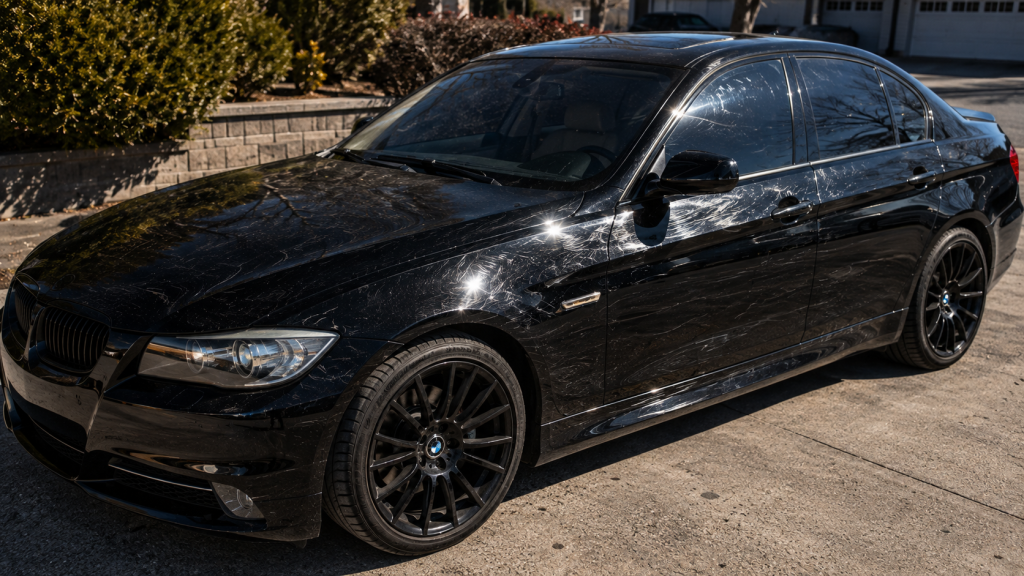
Direct sunlight makes this worse it reveals fine swirl marks detailers call this the hologram effect that are invisible under normal light but impossible to miss once the sun hits the panel at the right angle.
That visibility problem cuts both ways. If water spots are already showing up on your paint, our guide on removing water spots from your car covers both household and commercial removal methods.
There’s a psychological side to this too. Black car owners tend to wash more often because the car looks dirtier, not because it actually is.
More washing means more contact with the paint, and more contact means more chances for a scratch unless the technique is right.
Tools and Products That Matter Most
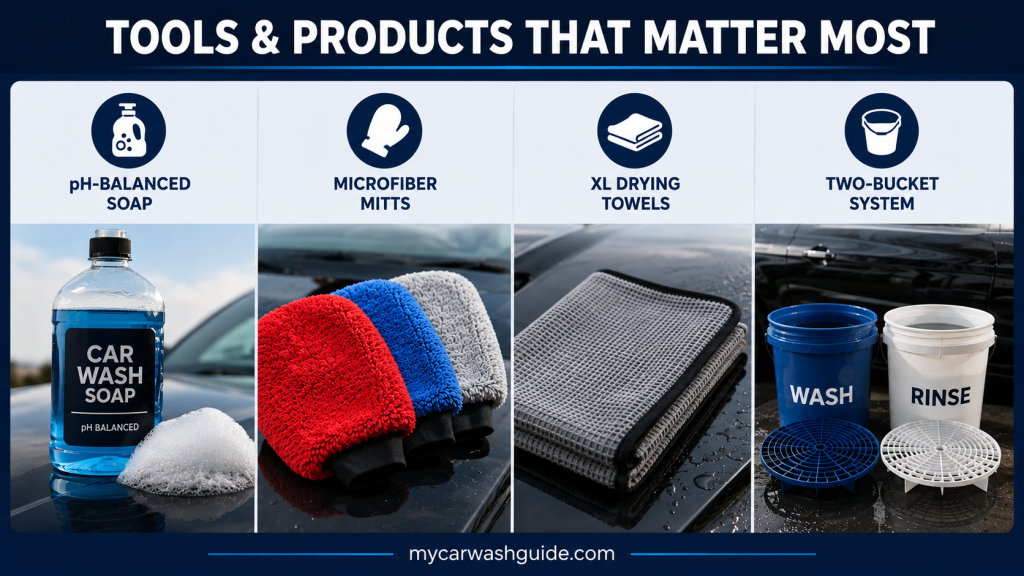
Four items are non-negotiable for black cars. pH-balanced car wash soap, color-coded microfiber wash mitts, XL-sized drying towels, and a two-bucket system with grit guards. Everything else is secondary.
pH-Balanced Car Wash Soap
Regular dish soap strips wax and dries out rubber seals it’s built to cut grease, not protect paint.
A pH-balanced car wash soap lifts dirt without stripping the protective layer underneath which matters more on black paint, since any dry spot or streak shows up instantly.
Dawn and other dish soaps are a bad idea on black cars their degreasers strip wax and ceramic coatings, which means more frequent reapplication and swirl marks that show up faster.
You save $5 on that one wash, then spend $50 to $200 a year reapplying wax you didn’t need to strip in the first place.
Stick to soaps in the 6.5 to 8.5 pH range. Dr. Beasley’s Premium Body Wash, Chemical Guys Black Light, and Turtle Wax Hybrid Solutions Ceramic Wash & Wax are all built for this.
Most dilute at 1:10 to 1:20 follow the bottle, since too strong a mix just leaves residue behind on black paint instead of rinsing clean.
Color-Coded Microfiber Mitts
Microfiber isn’t a marketing gimmick. Its soft fibers cause far less friction than cotton or synthetic mitts, which is exactly what black paint needs.
Color-coding matters just as much. Keep separate mitts for wheels, body, and windows red for wheels, blue for windows, white or gray for body panels.
Wheel grit is the dirtiest thing that touches your car, and dragging even a trace of it onto clean paint is how deep scratches happen.
Stick to an 80/20 polyester-polyamide blend and skip the cheap synthetic mitts they shed fibers and scratch paint instead of protecting it.
Go bigger too an 8 to 10 inch mitt covers more surface per pass, which means fewer total passes and less cumulative scratch risk.
Retire a mitt after 50 to 75 washes, or the moment it starts looking worn.
XL Drying Towels
A good waffle-weave or microfiber towel holds two to three times more water than a standard one.
That means fewer passes across the paint and less friction overall and fewer passes is the whole point, since every extra swipe is another chance to trap a piece of grit against the surface.
For the full breakdown of towel types, blowers, and drying aids, check our guide to drying a car after washing.
Two-Bucket System With Grit Guards
One bucket holds soapy water, the other holds plain rinse water. Dunk, wash a section, rinse the mitt before going back for more soap.
Grit guards sit at the bottom of each bucket and trap debris so it doesn’t circle back onto your mitt. Skip this setup and you’re just wiping dirt around the car with a soapy rag.
The Scratch-Free Washing Sequence
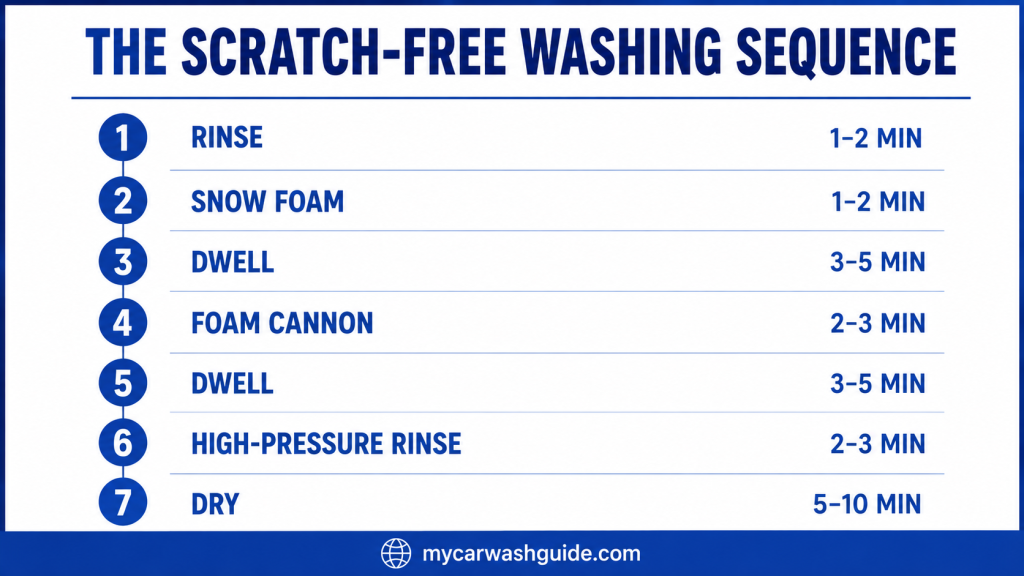
Rinse, snow foam, dwell, foam cannon, dwell, high-pressure rinse, then dry. Skip a step and scratches sneak back in.
- Timing wash during cool hours early morning or late afternoon. Heat dries soap onto black paint before you can rinse it, forcing aggressive drying that causes scratches.
- Direction always work roof down, so dirt from upper panels doesn’t migrate onto lower ones.
- Pressure 40–60 PSI for foam, 60–80 PSI for rinsing. Stay under 100 PSI anything higher can force water under trim and strip coatings.
- Dwell time let foam sit for 3–5 minutes. Less, and it hasn’t broken the bond between dirt and paint. More, and it starts drying on the surface.
- Bucket setup one bucket for soapy water, one for rinse water, grit guards in both so debris settles before your mitt goes back in.
For the full breakdown of the two-bucket method and complete wash process, our guide to washing a car at home covers every step.
Air Drying vs Microfiber Towel Drying
Air drying eliminates towel-to-paint friction completely no towel means no chance of dragging debris across the surface.
It takes 30 to 60 minutes depending on humidity and temperature, but the scratch-free result is worth the wait.
Use waffle-weave or twisted-loop microfiber towels instead. Apply zero pressure and let the towel’s absorbency do the work don’t drag or rub, just lay it flat and lift.
Use separate towels for the body, wheels, and windows so nothing cross-contaminates.
For the final rinse, switch to distilled water or a hydrophobic drying aid spray. Both cut down on the mineral deposits that leave water spots on black paint once it dries.
Maintaining Black Paint Between Washes
Detailing spray only handles light dust and fingerprints anything heavier needs a full wash. But using it regularly cuts down how often you need a full wash, which lowers your cumulative scratch risk over time.
Work one panel at a time spray, then wipe with a microfiber cloth using zero pressure. Don’t spray the whole car and let it sit that just leaves residue behind.
Bird droppings and tree sap are the exception. Soften those with distilled water first instead of wiping over them directly, since they’re abrasive enough to scratch on contact.
Most black cars need a full wash every 7 to 14 days, though that shifts with your environment coastal salt spray, tree sap, and industrial fallout all push that window shorter.
On the other end, washing more than twice a week actually works against you more contact means more scratch risk, not less. Detailing spray in between is what lets you stretch that gap safely.
For the full picture on how washing frequency affects protection across seasons, our guide on how often you should wash your car covers it in depth.
Long-Term Protection with Ceramic Coatings
Ceramic coatings are nano-ceramic polymers that bond to the clear coat, forming a protective barrier.
They don’t stop scratches from happening, but they make existing marks less visible and cut the time between washes by 30 to 40%.
Professional-grade coatings run $500 to $2,000 and last 5 to 10 years. DIY consumer kits cost $30 to $150 and last 1 to 3 years.
For black cars specifically, the math tends to work out less frequent washing and easier water spot removal offset the upfront cost within 3 to 5 years.
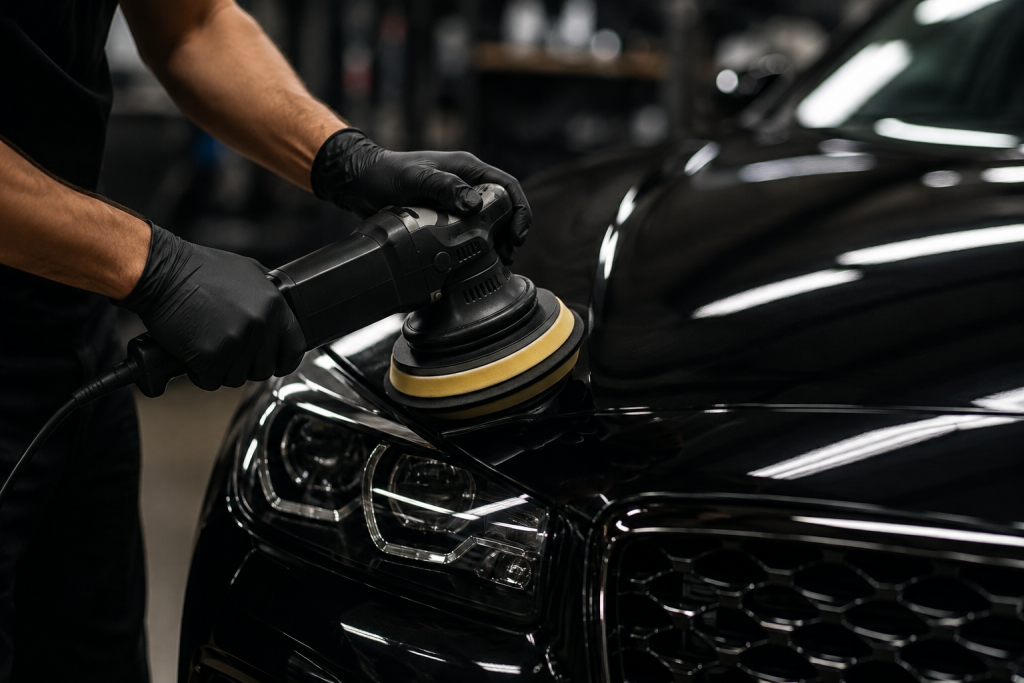
Coating over existing damage just seals it in. Clay bar or polish the paint first to remove swirl marks, then apply the coating once the surface is genuinely clean.
Skip that step and you’re locking in every flaw that’s already there. If you’d rather go the wax route instead of ceramic, our guide to waxing a car by hand covers technique and product picks for dark paint.
The coating won’t stop dust and fingerprints from landing on the car it just makes them wipe off easier, which is most of the battle on black paint anyway.
Frequently Asked Questions
What if swirls already exist
Start with a clay bar at $10-$20 to remove surface contaminants. If swirls persist, professional machine polishing at $200-$500 provides the most dramatic improvement on black paint.
Does garage storage help
Yes. Indoor storage eliminates environmental contaminants and reduces washing frequency by 30-40%. Use breathable car covers if garage space is unavailable.