How Often Should You Wash Your Car


The standard advice every two weeks only covers half the story. How often you should actually wash depends on how much you drive, where you live, and what your paint faces daily.
A car parked under trees in a coastal city needs completely different care than a garage-kept vehicle driven mostly on highways.
Skipping washes during high-risk seasons costs more in permanent damage than the time and money regular washing takes.
As a starting point wash weekly if you drive daily in a coastal area, near salt-treated winter roads, or park under trees with sap and bird droppings.
AAA recommends washing at least every two weeks through winter, and more often after driving on heavily salted roads, with extra attention to the undercarriage where salt does the most damage.
Every 2 weeks works for typical suburban driving. Once a month is enough for a garage-kept car driven occasionally. Hard water in your area pushes the frequency up too our guide on removing water spots covers why.

- High-mileage drivers wash every 10-14 days low-mileage every 3-4 weeks
- Under-washing risks permanent damage rust, etching over-washing only costs time and money
- Coastal and winter drivers wash every 7-10 days corrosion repair runs $500-$3,000
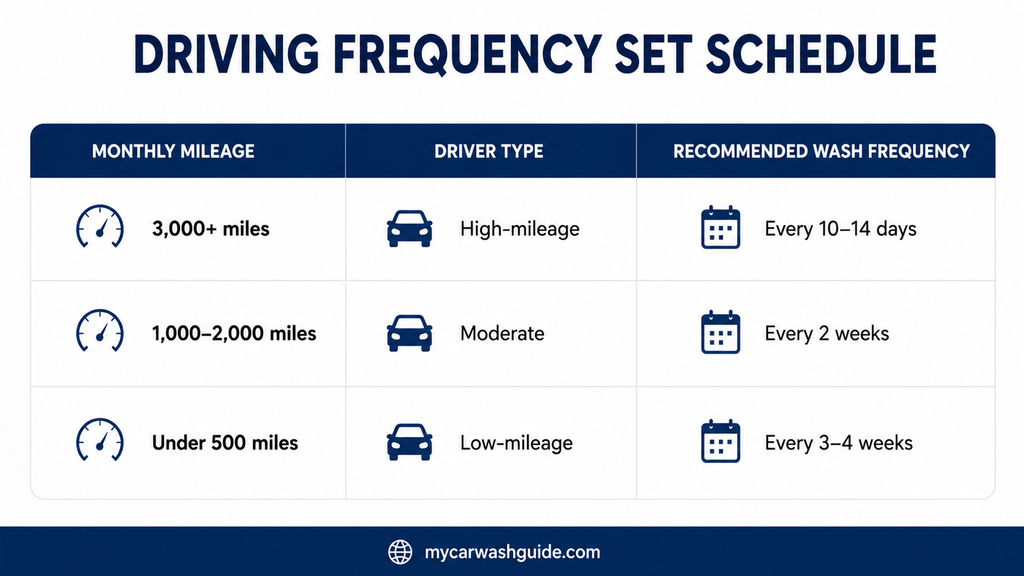
Driving Frequency Set Schedule
The two-week baseline misses the actual determining factor how many miles you drive each month. More miles means faster buildup of brake dust, pollution particles, and road tar on the paint.
| Monthly Mileage | Driver Type | Recommended Wash Frequency |
|---|---|---|
| 3,000+ miles | High-mileage | Every 10–14 days |
| 1,000–2,000 miles | Moderate | Every 2 weeks |
| Under 500 miles | Low-mileage | Every 3–4 weeks |
The type of miles matters too. Highway driving exposes paint to UV and wind but accumulates fewer contaminants. City driving collects brake dust, industrial fallout, and pollution, requiring more frequent washing despite lower total mileage.
Climate & Geography Adjustments
Salt spray, road salt, tree sap, and pollution each attack paint differently, and location often overrides how much you actually drive.
Coastal air corrodes metal and clear coat even on a car that barely leaves the garage. Wash every 7-10 days, and rinse the undercarriage where salt collects unseen.
Winter and salt-belt regions face the same risk from a different source road salt used for ice control is one of the most corrosive things your car meets, so wash weekly during salting season and pay attention to the wheel wells and undercarriage, where rust actually starts.
Heavy tree cover brings a faster-moving problem.
Sap and bird droppings are acidic and can etch clear coat within days, so spot-clean them the moment you notice rather than waiting for the next scheduled wash.
Industrial and high-pollution areas work on a similar timeline airborne particulates bond to paint quickly enough that a 2 week schedule often isn’t enough, and weekly washing keeps them from setting.
Desert and dry climates are the exception. Less moisture means less contamination from salt or sap, but intense UV exposure and dust still call for regular washing to prevent oxidation.
Cost of Under-Washing vs Over-Washing
Frame the decision as risk management, not perfection. Under-washing causes permanent, irreversible damage. Over-washing wastes only time and money.
| Cost / Service | Estimated Cost |
|---|---|
| Rust Repair | $500–$3,000 |
| Paint Etching Correction | $1,000–$5,000 |
| Frame Corrosion Treatment | $2,000–$8,000 |
| Bi-Weekly Washing (Annual) | $400–$1,200 |
| Weekly Washing (Annual) | Under $1,500 |
Rust repair costs scale sharply with how long damage sits a cheap sand-and-paint job at the surface stage can turn into a cut-and-weld repair costing many times more once it bubbles and perforates the metal.
That’s the core argument for washing on schedule: catching contamination early is what keeps the bill on the low end of every range above.
The math is clear. Spend $400-$1,500 a year on washing, or risk $500-$8,000 in damage repair from a single neglected season.
Washing more often than necessary is a waste of time. Washing less often than necessary is financial self-harm.

Recognizing Under-Washing
Visible damage means you’ve already missed the optimal wash window, but catching it early still prevents worse damage.
If water spots have already formed, our guide on removing water spots from your car covers both household and commercial removal methods.
- Water spots mineral deposits from contaminated water sitting on paint. If the surface feels rough to the touch, etching has already started.
- Bird dropping marks white or clear etched spots that won’t wash off, a sign of acid damage to the clear coat.
- Rust spots on trim orange or brown discoloration on chrome, trim, or exposed metal, usually from salt exposure without adequate rinsing.
- Dull paint a sign of oxidation and contaminant bonding, where the surface stops reflecting light clearly.
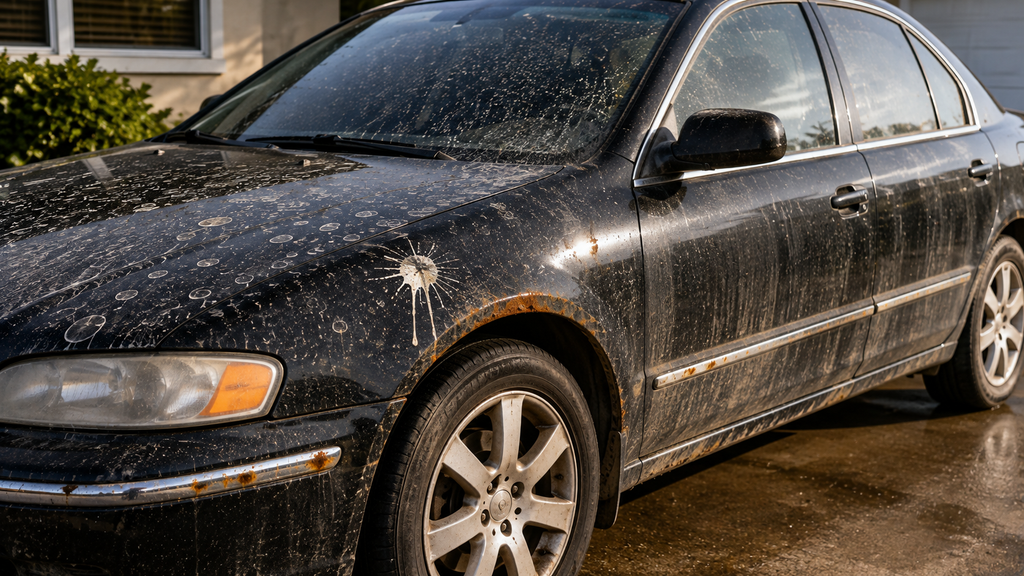
Damage progresses fast once it starts two weeks of neglect shows up as visible etching, four weeks as corrosion, eight weeks as damage needing professional correction.
Catch any of these signs and bump up your wash frequency right away.
DIY Washing vs Professional Services
Wash method matters less than technique a careful DIY wash protects paint as well as a professional one, and a rushed professional wash can still cause swirls.
DIY risks come down to dirty wash water, the wrong soap, or poor technique. Professional washing costs more but removes that risk entirely.
If you want a touchless option that minimizes scratch risk, our guide on how to use a touchless car wash covers the full process from prep to drying.
A hybrid approach is the most cost-efficient a professional wash every 4 weeks at $25-$50, plus a DIY rinse every 2 weeks at minimal cost.
This keeps protection consistent while holding annual costs to $600-$900. For the DIY portion, our guide to washing a car at home covers the two-bucket method and safe technique.

Touchless washes are gentler but less thorough brush washes clean better but risk swirl marks with poor technique.
Pick based on your paint’s current condition and how comfortable you are doing it yourself.
Once you’ve finished washing, proper drying matters just as much our guide to drying a car after washing covers blowers, towel selection, and drying aids.
Quick-Reference Decision Tree
Not sure which section applies to you. Find your situation below and go straight to the number.
| Your Situation | Recommended Wash Frequency |
|---|---|
| High-mileage city driver (3,000+ mi/month) | Every 10–14 days |
| Coastal resident, salt spray exposure | Every 7–10 days |
| Winter climate with road salt | Every 7–14 days |
| Highway commuter, mostly highway miles | Every 3–4 weeks |
| Parked under trees (sap, droppings) | Every 10–14 days |
| Garage-parked, low-mileage driver | Every 21–30 days |
| Ceramic-coated paint | Every 2–3 weeks |
| Matte finish paint | Every 10–14 days |
If more than one situation applies say, coastal exposure plus high mileage go with the most frequent interval on the list.